
Smarter Government Procurement: Better Sourcing, Stronger Compliance, and More Reliable Delivery | NMH Tech, Inc.
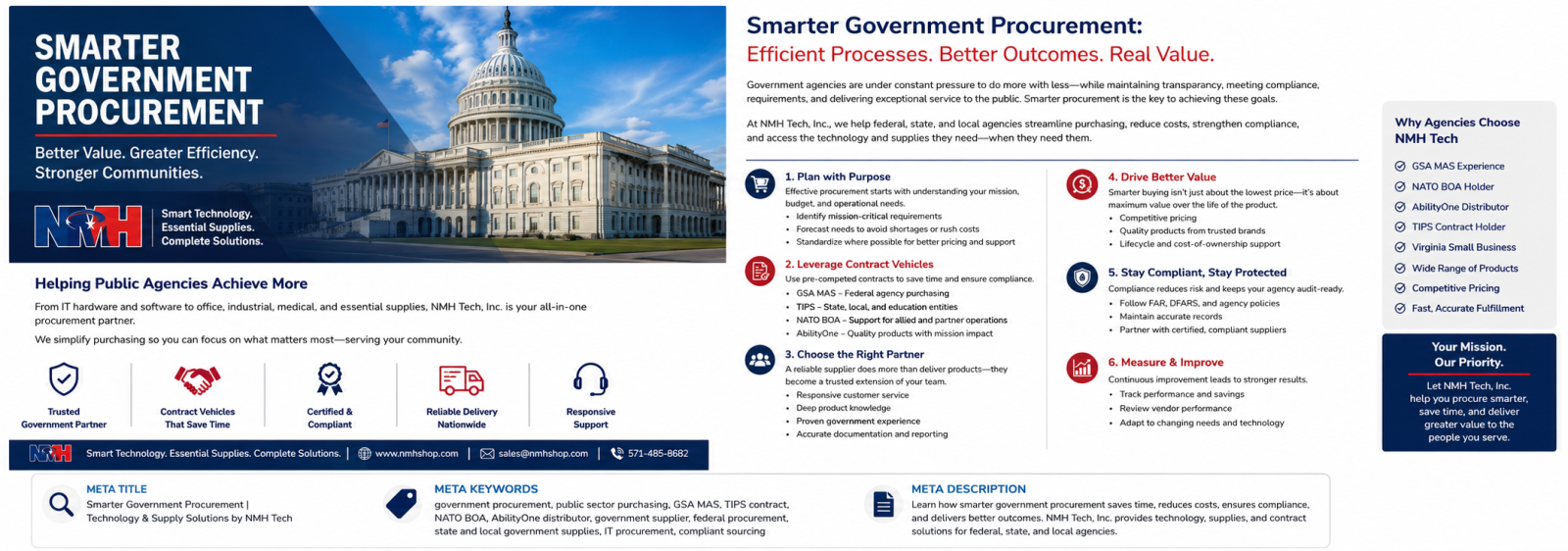
Government procurement plays a critical role in keeping agencies operational, secure, and prepared to serve the public.
From computers, networking equipment, software, and office supplies to industrial, safety, medical, and facility products, federal, state, and local government organizations depend on reliable B2B suppliers and efficient procurement processes to obtain the right products at the right time.
Successful government purchasing involves more than selecting the lowest-priced item. Procurement teams must balance product quality, competition, contract requirements, supplier responsibility, delivery schedules, documentation, cybersecurity, supply-chain integrity, and responsible use of public funds.
A structured B2B procurement strategy can help agencies reduce administrative delays, improve order accuracy, manage costs, and build stronger relationships with dependable suppliers.
Start With a Clearly Defined Requirement
Every successful government purchase begins with a clear and complete description of the requirement.
Incomplete specifications can result in:
- Incorrect quotations
- Product incompatibility
- Unnecessary substitutions
- Delivery delays
- Increased administrative workload
- Higher overall costs
Before requesting pricing, purchasing teams should identify:
- Manufacturer
- Product name
- Manufacturer part number
- Required specifications
- Quantity
- Unit of measure
- Compatibility requirements
- Required accessories
- Warranty requirements
- Delivery location
- Required delivery date
- Installation or configuration needs
- Packaging or labeling requirements
- Contract requirements
- Security requirements
- Regulatory or compliance requirements
For technology purchases, agencies should also evaluate operating-system compatibility, processor performance, storage capacity, networking standards, cybersecurity requirements, licensing, and future expansion needs.
A clearly defined requirement helps suppliers provide accurate quotations and enables procurement teams to compare competing offers more effectively.
Conduct Meaningful Market Research
Market research helps agencies understand available products, suppliers, contract vehicles, commercial solutions, pricing, and supply-chain conditions before issuing an RFQ or placing an order.
Effective market research may include:
- Reviewing manufacturer specifications
- Comparing products from multiple brands
- Evaluating current commercial pricing
- Reviewing historical purchases
- Identifying qualified small businesses
- Reviewing available contract vehicles
- Confirming current product availability
- Comparing warranty and support options
- Reviewing delivery lead times
- Identifying discontinued products
- Evaluating replacement models
- Assessing supply-chain risks
Market research should help determine whether a requirement is commercially available, competitively priced, technically appropriate, and capable of supporting the agency's mission.
Select the Appropriate Purchasing Method
Government buyers may have several purchasing methods available depending on the requirement.
These may include:
- Government contract vehicles
- Cooperative purchasing contracts
- Blanket Purchase Agreements
- Indefinite-delivery contracts
- Purchase cards
- Mandatory sources
- Open-market acquisitions
- Agency-specific purchasing programs
The appropriate purchasing method may depend on:
- Order value
- Product category
- Delivery urgency
- Competition requirements
- Available contract vehicles
- Small-business requirements
- Agency procurement policy
- Product availability
- Required terms and conditions
Using an appropriate purchasing vehicle can reduce procurement time, simplify documentation, and provide access to established suppliers and pricing.
Agencies should also verify whether mandatory-source requirements apply before purchasing through an alternative source.
Encourage Effective Competition
Competition can help agencies obtain:
- Competitive pricing
- Better service
- Improved delivery commitments
- Greater product choice
- Stronger purchasing outcomes
However, quotations should be compared on an equivalent basis.
Procurement teams should verify that competing quotations include:
- Correct manufacturer part number
- Correct quantity
- Equivalent specifications
- Required accessories
- Applicable warranty
- Shipping and freight
- Delivery timeframe
- Contract information
- Payment terms
- Quote validity
- Product availability
The lowest quoted unit price may not represent the best overall value if the supplier cannot meet delivery requirements, excludes freight, offers an incorrect configuration, or provides insufficient warranty coverage.
Evaluate Total Value, Not Only Unit Price
Government procurement must protect public funds, but the lowest initial purchase price does not always provide the lowest total cost.
Total acquisition cost may include:
- Product price
- Shipping and freight
- Installation
- Configuration
- Software licensing
- Subscription renewals
- Accessories
- Maintenance
- Technical support
- Energy consumption
- Replacement parts
- Training
- Product lifecycle
- Disposal or recycling costs
For example, a lower-priced computer that cannot support future operating systems, cybersecurity applications, or required workloads may need to be replaced sooner than a better-supported alternative.
Smart procurement evaluates price, performance, compatibility, warranty, reliability, delivery, and lifecycle cost together.
Work With Qualified B2B Suppliers
A dependable government supplier should provide more than a price.
The supplier should understand the requirement, identify the correct product, communicate availability accurately, and provide complete commercial and procurement documentation.
Agencies may evaluate suppliers based on:
- Business registration
- Contract eligibility
- Small-business certifications
- Product knowledge
- Manufacturer or distributor relationships
- Past performance
- Financial capability
- Operational capability
- Delivery history
- Customer-service responsiveness
- Warranty support
- Return and replacement procedures
For technology, medical, industrial, and safety products, agencies should also consider whether the supplier can provide products through reliable and traceable supply channels.
Protect the Supply Chain
Supply-chain integrity is especially important when purchasing:
- Computers
- Networking equipment
- Communications products
- Storage devices
- Security products
- Medical supplies
- Industrial products
- Safety equipment
Products obtained through unclear or unreliable channels may create risks including:
- Counterfeit equipment
- Altered serial numbers
- Missing manufacturer warranties
- Used products represented as new
- Incorrect regional models
- Unsupported configurations
- Outdated firmware
- Missing accessories
- Cybersecurity vulnerabilities
Agencies should work with suppliers that can provide accurate product identification, original packaging, clear warranty information, and reliable return procedures.
Unusually low pricing should be evaluated carefully when it appears inconsistent with normal commercial market conditions.
Improve RFQ and Quotation Accuracy
Standardized RFQ and quotation requirements can reduce procurement delays and improve comparison between suppliers.
A complete B2B government quotation should generally identify:
- Supplier name
- Supplier contact information
- Quotation number
- Quotation date
- Manufacturer
- Product description
- Manufacturer part number
- Quantity
- Unit price
- Extended price
- Contract number, when applicable
- Shipping and freight
- Delivery estimate
- Warranty information
- Quote expiration date
- Payment terms
- Availability
- Approved substitution information
Accurate documentation helps procurement, receiving, finance, property-management, and audit personnel verify that the correct products were ordered, delivered, accepted, and paid for.
Plan Delivery Before Award
Delivery requirements should be established before the order is placed.
Government buyers should communicate:
- Complete delivery address
- Receiving hours
- Delivery contact
- Loading-dock availability
- Security or access requirements
- Appointment requirements
- Inside-delivery requirements
- Liftgate requirements
- Required delivery date
- Partial-shipment acceptance
- Packaging instructions
- Labeling requirements
Suppliers should distinguish between an estimated ship date and an estimated delivery date.
For urgent or mission-critical requirements, delivery expectations should be clearly documented in the quotation or order confirmation.
Manage Product Substitutions Carefully
Technology and commercial products are frequently updated, discontinued, or temporarily unavailable.
When a supplier recommends an alternative product, the replacement should be reviewed before shipment.
Substitutions should be evaluated for:
- Technical performance
- Compatibility
- Form factor
- Dimensions
- Included accessories
- Warranty
- Licensing
- Country of origin
- Regulatory compliance
- Pricing
- Availability
- Delivery timeframe
Products should not be substituted without approval when the manufacturer, part number, or technical specification is material to the requirement.
Approved substitutions should be documented clearly.
Use Small Businesses Strategically
Qualified small businesses can provide government buyers with:
- Responsive customer service
- Specialized product knowledge
- Flexible sourcing
- Access to multiple manufacturers and distributors
- Faster quotation support
- Assistance with hard-to-find products
Agencies can support effective small-business participation by:
- Conducting early market research
- Publishing clear specifications
- Avoiding unnecessary bundling
- Providing realistic response deadlines
- Using appropriate set-asides
- Identifying accurate product categories
- Communicating anticipated requirements
- Considering experienced small-business resellers
Small-business suppliers can be particularly valuable for specialized sourcing, difficult-to-find products, project-based requirements, and recurring supply needs.
Track Supplier Performance
Supplier performance should be evaluated after award and delivery, not only during source selection.
Useful performance measures may include:
- RFQ response time
- Order accuracy
- On-time delivery
- Product condition
- Documentation accuracy
- Invoice accuracy
- Return frequency
- Warranty support
- Backorder frequency
- Customer-service responsiveness
Tracking supplier performance helps agencies identify dependable procurement partners and address recurring problems before they affect future requirements.
Use Purchasing Data to Improve Future Procurement
Historical purchasing data can help government organizations improve planning, budgeting, sourcing, and inventory management.
Procurement teams may review:
- Frequently purchased products
- Average order value
- Price trends
- Supplier performance
- Delivery performance
- Seasonal demand
- Emergency purchasing frequency
- Product-return rates
- Recurring supply requirements
- Equipment replacement cycles
This information can support better budget forecasting, contract planning, product standardization, inventory management, and supplier selection.
Government Procurement Checklist
Before approving a purchase, confirm that:
- The requirement is clearly defined
- Product specifications are accurate
- Market research has been completed
- The appropriate purchasing method has been selected
- Competition requirements have been addressed
- Small-business participation has been considered
- Mandatory sources have been reviewed
- Supplier responsibility has been evaluated
- Pricing is clearly documented
- Freight and shipping are understood
- Delivery requirements are documented
- Warranty terms have been reviewed
- Substitutions require authorization
- Supply-chain risks have been considered
- Receiving procedures are established
- Procurement documentation is complete
How NMH Tech Supports Government Procurement
Founded in 2014, NMH Tech, Inc. supports federal, state and local government agencies, educational institutions, healthcare organizations, government contractors, and other professional buyers with B2B product sourcing and procurement solutions.
Our product portfolio includes:
- Computers and IT hardware
- Networking and communications equipment
- Software and cloud solutions
- Office and workplace supplies
- Printing and imaging products
- Industrial and MRO supplies
- Facility products
- Medical and healthcare supplies
- Scientific and laboratory products
NMH Tech is a certified Virginia Small Business, NATO Basic Ordering Agreement holder, AbilityOne distributor, and TIPS contract holder. The company has also previously held a GSA Multiple Award Schedule contract, providing experience with structured public-sector procurement and government purchasing requirements.
We support government and institutional customers with:
- RFQs and quotation preparation
- Purchase Orders
- Bulk and volume purchasing
- Recurring supply requirements
- Specialized sourcing
- Product identification
- Availability confirmation
- Delivery coordination
- Order documentation
- Project-based procurement
For B2B pricing, product availability, volume requirements, or government procurement support, contact:
NMH Tech, Inc.
Phone: 571-485-8682
Email: sales@nmhshop.com
B2B Technology. Essential Supplies. Complete Procurement Solutions.